Games and Tools, Positive Psychology

Working with Strengths Cards: 3 Exercises for Workshops & Coaching

Working with Strengths Cards: 3 Exercises for Workshops & Coaching
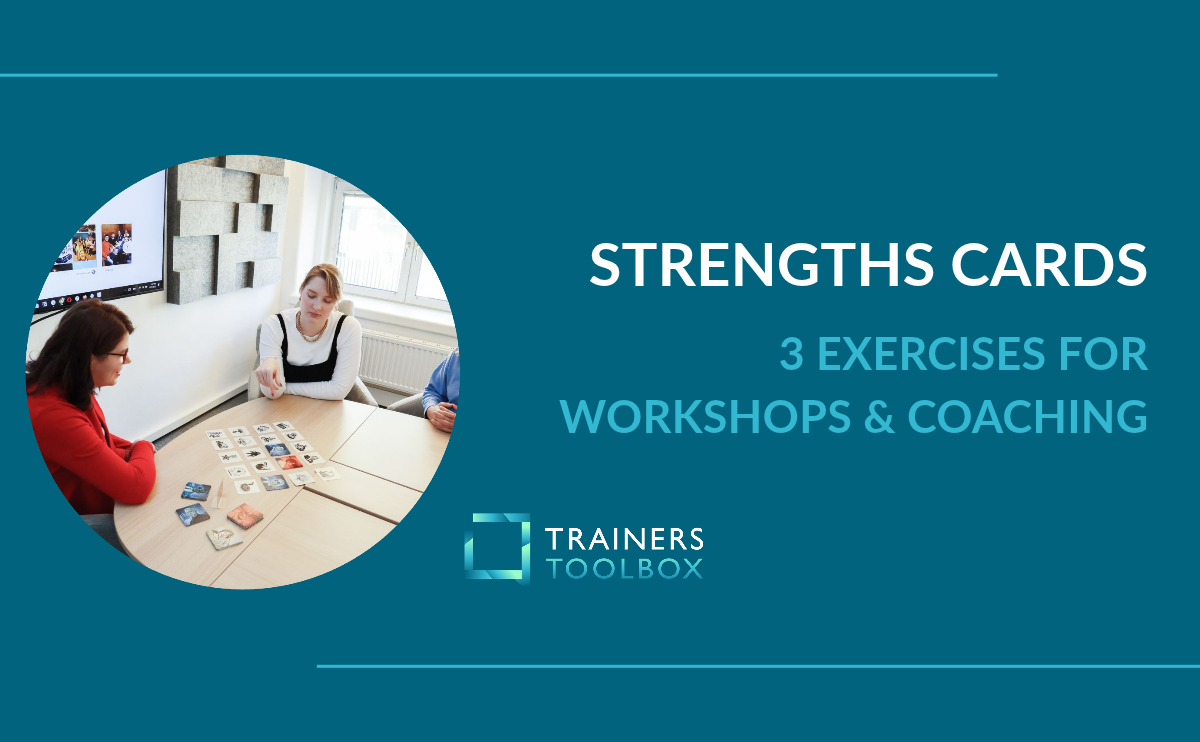
The practical exercises I use in my workshops and 1:1 coaching, plus my favourite card decks and why they are worth trying

Every trainer likes a good card deck, and strengths cards will easily become one of your favourites.

While strengths are one of the most powerful topics to bring into any self-development or team-development conversation (not sure about it? explore why that is), cards can add a layer of self-reflection and intuitive thinking that (verbal) questions often do not have.

Why? Because they remove the “blank page.”

Ask someone to name their strengths from nothing and watch what happens. They will struggle, probably lean towards the two or three words everyone reaches for, and they definitely will not be thinking big or creative.

Of course, you can get past that by using some really good questions or one of the strengths assessments, but cards tend to be an easy-going, playful, colourful shortcut to surprisingly insightful answers.

Spread 50 cards on a table and the words and ideas suddenly flow in. Curiosity in the room becomes palpable. Nobody has to generate vocabulary. They only have to choose which of the keywords align with them best.

There are two more things a deck gives you that are easy to overlook:

Choosing becomes physical and visible:
Picking up a card, holding it, putting it back and picking a different one somehow makes thinking visible. You can see who is hesitating and who is certain, which can open a whole new direction of a conversation. You can see what dilemmas people have, and what hesitations might be holding them back.

A card can be handed over:
You can say out loud what strength you see in someone, but when you put a card in their hand and say what you see them do, that small physical act changes the moment completely.

This article is about the exercises that leverage exactly those properties of physical strengths cards. I am sharing 3 very diverse exercises (and you will find a link to 5 more at the end). As always in workshop design, I would invite you to pick the right one based on the goal of your workshop.

Exercise 1: The Strengths Sort

Individual exercise, or one-to-one in coaching. Can take between 10 and 45 minutes, depending on how deep you go.

This is such a great exercise, and the deck makes it very simple and engaging.

Important on materials: if you run this with a group, you need one deck per person. Everyone is sorting the whole pack at the same time, so they cannot share. It is also a great exercise in one-to-one coaching, where one deck is all you need.

Step 1: 4 piles

Explain the 4 categories, then let people place every card from the pack into one of them.

My strengths: what they already know they have and use often, which lets them perform at their best.

My potentials (underused strengths): strengths they may not get to express daily because of their environment or role. When they do use them, they get energy and satisfaction from it.

My learned skills: things they have learned to do well over time, but which give them no pleasure or energy. The results are fine, but using these is often more draining than energising.

My weaknesses or blind spots: things they cannot do well and that drain them, or characteristics they are genuinely not sure apply to them. (Optional: you can add a 5th pile for blind spots, but I prefer to keep it simpler.)

Step 2: Work through the piles one at a time

Are the strengths being used well, or overused? How could the potential be developed for each strength? How could the learned skills be used less, given they often cost energy?

(Here you can adapt the process a lot to your context, group or goals, picking the questions according to the focus of your workshop.)

Step 3: Decide which pile is most relevant to explore (or explore all 4)

While we definitely want to look into using our strengths more, the two most interesting piles are usually learned skills and underused strengths.

This leads us right into the discussion of how being good at something is not the same as it being a strength. Most people have never separated the two, and seeing a pile of things they are good at and quietly drained by is often the most useful moment of the whole session. It protects their performance, but even more it protects their energy and motivation by showing how to leverage those underused strengths.

The next step can be a conversation about which of these learned skills we could replace by using our authentic strengths more.

Step 4: Decide on the weaknesses

Develop them, ignore them where possible, or find creative ways to compensate, for example by pairing up with someone whose strengths cover them. This is also the place to look at those underused strengths, and how they can help us improve in the areas that are weaknesses for us.

(Note: you can discuss how to compensate for weaknesses within yourself by using some of your underused strengths, or have this discussion on a team level, how we complement each other.)

In the metaFox Inner Journey course, day 3 is dedicated to personal strengths. We dive deep into your own report of these four groups (strengths, potential, learned skills and weaknesses) in a coaching conversation where you explore how to leverage your underused strengths more. More importantly, you learn how to run this kind of conversation with your own coaching clients or participants. Join me to upgrade your skills and toolbox as a trainer or coach.

Exercise 2: The Strengths I See in You

Group or team, 4 to 12 people. 30 to 40 minutes. One or two decks for the whole group.

Important note: this exercise is great for a group that already knows each other a bit, so use it at the end of a longer programme, or with a team. It is also crucial to keep it authentic: nudge people to be honest and really give thought to the strengths they give to others.

Step 1: Spread the deck

All cards face up on a table where everyone can reach.

Step 2: Choose for each other

Each person picks 1 or 2 cards for every other person in the group.

Step 3: Hand them over

One at a time, people give the card to the person it is for and say why they think they have this strength (an example of where they saw it in their behaviour). Not “you are creative”, but the moment: what happened, what that person did, what it made possible.

(Note: with a bigger group, you can split into groups of 3, and in each triplet each person chooses 1 or 2 cards for the other 2 people.)

Step 4 (optional): The receiver responds

A sentence is enough. Whether it surprised them, whether they had noticed it themselves, or any questions.

Why the physical hand-over matters: this exercise also exists as a written version, with sticky notes or envelopes, and that works well. But giving somebody a card is a different act. There is a small ceremony in it, and people keep the cards.

Watch for this: the rule that makes or breaks it is the concrete example. Without it, the whole thing becomes a round of compliments that everyone enjoys and nobody remembers.

Exercise 3: Strengths for a Challenge

Individual, pairs or one-to-one coaching. 20 minutes. One deck per pair, or one each.

Most card exercises stop at discovery. This one starts there and then goes deeper, planning how to put the strengths into action in a real-life challenge.

Step 1: Name the stuck point

Each person names a current challenge, something real that is present for them right now in their life or work.

(Note: depending on the time you have and the depth of your workshop, be clear on what size of challenge they should choose. In most cases you will invite them to pick something real that they care about, but not something overwhelming or highly vulnerable.)

Step 2: Pick a card

Which strength, if they used more of it, would help them here? They pick the card and hold it. (Variation: they could pick 2 or 3 cards.)

Step 3: Get specific

How exactly would that strength show up here? How could they put it into action? What would they say or do differently on Monday?

Step 4: One action

One concrete step, written down, with an exact date attached.

Why this one can be so valuable: it answers the question every strengths session eventually runs into, so what do I actually do with this? Ending a strengths workshop here rather than at the discovery stage is often the difference between a nice hour and a session people act on.

Which strengths card decks are worth having?

There are many great strengths decks out there (and you might find others that did not make this list), but there are three I use and recommend:

Positran Strengths Cards

Designed by Professor Ilona Boniwell, one of the European leaders in positive psychology and CEO of Positran. The 50 strengths are a synthesis of the main existing strengths classifications (VIA among them), so the deck covers a broader vocabulary than VIA’s 24 character strengths. Each card has a photo and the strength name on the front, and on the back the questions to identify it, a short description, plus suggestions for activating and developing it (these backs are what make the deck a facilitation tool rather than just a set of words). Available in English, French, German and Dutch. There is no digital version. Positran Strengths Cards.

metaFox Stronger You

52 cards, sorted into three areas of life: character, relationships and competency. The deck is inspired by Christopher Peterson and Martin Seligman’s Character Strengths and Virtues, the work behind the VIA classification. The strength term and an icon sit on the front, and an evocative image on the back, so you can work with association and intuition as well as language. Some cards are marked with a plus sign, so you can take them out for a smaller set. It comes with a booklet of 3 suggested methods and is available in English, German, French, Italian and Spanish. There is a digital version too: a downloadable set for Miro or Mural (not in French or Spanish), and the cards are on the metafox.online platform. metaFox Stronger You.

At My Best Strengths Cards

Created by Work Positive, a team of UK business psychologists, and built on positive psychology principles rather than one specific classification. 48 cards, a single word on one side and a photograph on the other. The words are everyday qualities like approachable, playful or warm, which keeps the language simple and accessible. The deck’s focus is helping people build the story of who they are at their best, a natural fit for appreciation exercises like The Strengths I See in You. It comes in two editions: the Premium Edition (48 cards plus 7 bonus category cards, an instruction booklet and a sturdy box), made for coaches and facilitators; and the Essential Edition (the same 48 cards in a smaller playing-card size, without the bonus cards or booklet, exercise guides online via QR code), sold in packs of 10 so everyone can have their own deck. There is also a digital version on Deckhive. At My Best Strengths Cards.

Digital options: metaFox has the most choice, with a downloadable digital set for Miro or Mural (not in French or Spanish), plus the cards on metafox.online. At My Best has a digital version on Deckhive. Positran has no digital deck, only separate online strengths diagnostics.

The core difference in one line: Positran gives you the most coaching content on the card itself. metaFox gives you the most structure and the best online and multilingual options. At My Best is the lightest and most open-ended, and the only one with a cheap multi-pack, which directly solves the “one deck per person” problem in the Strengths Sort exercise above.

Choosing a deck: a short guide

If you mostly coach one-to-one, or want ideas captured on the card so people can explore them on their own: use Positran, a deck with rich backs, so you have questions and prompts to hand without preparing them. metaFox Stronger You is another good option, a very practical size for coaching. You can also consider a simplified version of the Strengths Compass by metaFox.

If you mostly run groups: consider how many decks you will need (pricing can be a factor). The Strengths Sort needs one per person; everything else can share, though with a bigger group you will sometimes need 2 decks. If you need one deck per person, the At My Best Essential Edition (sold in packs of 10) is the most affordable way. (Note: if you use metaFox, you can mix one pack of strengths cards with one pack of their What Really Matters! values cards for a wider list of ideas.)

If your group speaks different languages: metaFox comes in English, German, French, Italian and Spanish.

If you work online: metafox.online or metaFox cards for Miro. At My Best has a digital deck on Deckhive. Positran has no digital version.

Prices and languages at a glance (do check their links, as pricing can change):

Positran Strengths Cards: EUR 34. English, French, German, Dutch.
metaFox Stronger You: EUR 40.95, digital set EUR 34.95. English, German, French, Italian, Spanish. (Use the code TRAINERSTOOLBOX10 for a discount on the metaFox deck.)
At My Best: Premium Edition GBP 25 + VAT, Essential Edition GBP 125 + VAT for a pack of 10, digital deck on Deckhive GBP 10 + VAT. English.

Want more strengths activities that need no cards at all?

Not every group has a deck, and not every budget stretches to one per person. In the next article you can explore 3 strengths activities you can run with nothing but paper and a pen.

And if you would like more ideas, explore this free 5-day series: one strengths activity a day, in writing and on video, covering exercises for individuals and for teams, from very short exercises to some that stretch over several weeks.

I also keep a public library of workshop activities on SessionLab, several of them strengths-based, and I keep adding to it. Check it out here.

Looking to work with cards in a deep, experiential way?

I facilitate The Inner Journey in diverse locations in Italy: 3 days working with emotions, images and strengths, built almost entirely on physical metaFox tools and live practice. Day 2 is picture cards, day 3 is all strengths. It is a great place to grow new skills and discover new tools as a trainer, facilitator or coach. Is this the right learning experience for you?

Or still looking for your "tribe" of trainers to explore tools and activities together?

Card decks (and all the best activities) are exactly the kind of thing we share and swap in Trainers Conversations, Trainers Toolbox’s year-round community of 22 trainers and facilitators. In 2027 I am also delivering a masterclass on the strengths-based approach inside the community (you can also sign up for the masterclass individually via Luma).

Curious but unsure if it is the right fit? Get in touch via contact or LinkedIn.

Where do you see you could enrich your workshop or coaching by using some of the exercises I shared?

author-avatar

About Mirna Šmidt

Trainer & facilitator with 18+ years of experience. Founder of Trainers Toolbox & Happiness Academy. On a mission to help trainers create deep, science-based learning experiences that actually stick. Let's connect on LinkedIn: https://www.linkedin.com/in/mirnasmidt/