Blog – old
Strengths Overused: What to Do When a Strength Turns Into a Weakness
A four-step model for making the most of your strengths without letting them slip into weaknesses. Use it on yourself, or with the participants in your workshops.
Imagine a trainer who is wonderfully decisive. She makes the call, keeps things moving, never lets the room stall.
On a good day, it is her superpower.
On a bad day, that same decisiveness has her pushing people to decide before they are ready, not allowing space for the quieter voices.
So a colleague tells her the obvious thing: be less decisive (or, not to be pushy).
She tries.
The room drifts, nothing lands, and she feels like she is fighting her own instincts.
It’s because the fix was never “less decisiveness”.
Instead, it was more patience.
A little more patience & more focus on listening and observing, and she could have stayed just as decisive, without running anyone over. She could have used her own superpower – decisiveness – while making sure that same superpower doesn’t become a danger, because she balances it well with another strength.
That is the whole idea of strengths overused, in a simple example.
Your greatest strength is also your greatest weakness. And the usual fix, “do less of it”, is the wrong one.
Let’s have a look at one more example, a very different one:
Imagine you are strong on empathy, and sometimes it leads you to neglect your own needs. Simply because a strong focus on another person can sometimes distract you from remaining focused on your own feelings and energy too. That would be your strength of empathy that created a danger because it was overused (or, it was out of balance).
Or another flavour of strength overused: a talent for structure can easily slip into rigidity. While it is such a great gift to be structured, if we overplay it, it can easily become a burden both for us and for people around us.
So what can we do to make sure our strengths don’t turn into weaknesses?
The advice that usually helps you keep those strengths from slipping into weaknesses is a version of the same thing: rein it in, be more moderate, do (a bit) less of it.
That advice can lead us to a trap.
By following this advice, we spend a lot of energy trying to be less of what we are – and, sadly, less of what we are actually good at.
It silently leads us to underuse our potential. And, in a way, to use less of our biggest strengths.
Yet, there is a model that approaches it differently. When I discovered it, it made me really excited that work with strengths finally got its final piece of the puzzle.
It is a model known as the Core Quadrant, by Daniel Ofman.
When working with strengths, I often bring this conversation about overused strengths into my trainings, usually after working on discovering our strengths and using strengths more, as an additional layer that deepens the conversation.
I also use it in the way I think about my own strengths – seeking a balance of complementary strengths, instead of beating myself up for being “too much” of something.
I love this model because it does not ask us to be less of what we are and what we are good at.
Instead, what it suggests is that when a strength is overused, the way to fix that balance is to develop a complementary strength that keeps it in healthy tension.
(Prefer to explore this model by listening or watching a video? Check out episode 34 of the Trainers Toolbox podcast, where I am exploring the same model.)
Before diving into the model: why would you use it in the first place, and the trap most of us fall into
Working from your strengths is a great way to create more energy and better results (I make the fuller case for that in Why Work With Strengths?).
But there is one trap even people already working from a strengths-based approach tend to miss: the thing that powers a strength is the same thing that powers its weakness. They grow from the same root.
So you cannot cut the weakness away without cutting into the strength.
What is actually a strength, and how is it different from a skill?
To fully understand the model, it is important to understand this distinction.
A skill is something you are good at.
Strengths are what you’re good at, you enjoy doing, and that also gives you energy.
Now, here is why keeping in mind the difference between strength and skill is super important when we work with this framework:
When you look for a complementary quality to balance an overused strength, you want it to be a strength, not just a skill.
A skill you need to power with effort, and over time that drains you. A strength that you feed gives energy back. Even one that is underdeveloped right now will, with time, give you much more energy than a skill that you are good at, but that drains you.
The Core Quadrant model in four steps
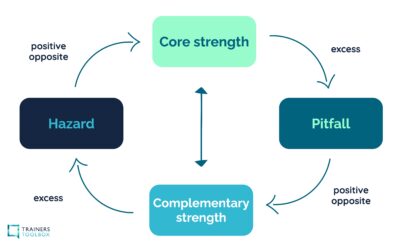
We can think of it as four steps that show how a strength can develop, and where it can tip over:
1. Core quality: your natural strength. The thing you are good at and it also gives you energy.
2. Pitfall: what that strength becomes when it is overused. Not a separate flaw, but the same quality pushed too hard.
3. Complementary strength (or antidote): the positive opposite of the pitfall. This is the complementary strength worth growing. It is not the direct opposite of your core quality – instead, it is the antidote to the pitfall. And it is also one of your strengths (although maybe one that you’ve been underusing). (Check the example below, it will make this more clear 🙂)
4. Hazard: what the antidote becomes if it gets overused. You will rarely land here yourself, but it is useful, because your hazard is often exactly what irritates you in other people, and that irritation can point you back to the antidote you need.
Together, those four steps show how one strength can grow, tip over, and be brought back into balance.
If you would enjoy using this model in your workshops, episode 34 of the Trainers Toolbox podcast walks through it in more depth.
Let's make it more tangible and clear with an example
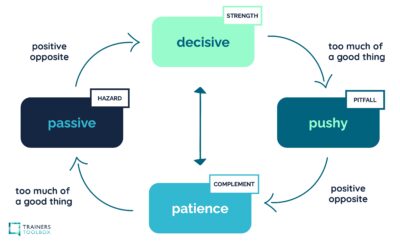
Take the example of the decisive trainer from the start. Here is how it would work out in that case:
Core quality: decisive. You move things forward; you make the call; you do not get stuck.
Pitfall: pushy. When overused, that decisiveness creates a lot of pressure on others. Maybe it pushes people to decide and act faster than they are ready to.
Here is the key that this model gives us: to bring this back to balance, the question we will explore is not how do I become less pushy? and it is not how do I become less decisive? Both of those just shrink you. The question is: what would I need more of, so the pushiness does not happen?
Complementary strength: patience. Grow your patience and you can stay fully decisive while giving people the room they need. Patience is not the opposite of decisiveness. You are not turning the strength down; you are adding the one that balances it. (Important: when picking that complementary strength, you really need to take into account your own personal strengths, and find the one that has the best potential to be an antidote to your pitfall. It will be a different complementary strength for different people, even if the core quality is the same.)
Hazard: passive. Overdo the patience and you tip into being passive. And notice: passivity is probably the thing that most annoys you in others. Which means you could have found your complementary strength from that end too, by asking what irritates you in people, spotting passive, and looking for its healthier, more moderate version. That is patience.
How is the approach of “complementary strengths” more powerful than diminishing our strengths?
Most models that deal with an overused strength ask you to be more controlled, more careful, and, in a way, to diminish. They keep you tense and require that you monitor yourself, requiring a lot of self-control and energy spent on self-regulation.
This one asks the opposite: lean fully into your strength, and grow the one complementary strength that keeps it pointed in the right direction. You keep your decisiveness, your empathy, your drive at full power, yet still stay in balance.
Working with this model frees people up instead of tightening them.
How to use this, on yourself and with the people you train
You can run this model as an exercise on paper in a few minutes.
On yourself
Pick a strength you are wary of overusing and go through the four steps of the model.
Or start from the other end: take a weakness you do not like in yourself. Ask which strength sits at its core, and treat that weakness as the pitfall.
With the people you train
A few things to hold in mind when you guide someone else through it.
- Only they have the right answers for themselves. You cannot tell someone their pitfall or their complementary strength from a list. Ask, do not assign: What happens when I overuse this? What would I need more of, so that does not happen?
- The complementary strength should feel energising, not like homework. Look for a strength they would enjoy growing, something already in them that they are not well connected to yet. If it feels like one more pressure, it is the wrong one.
- Offer directions – do not prescribe them. Suggest a few possible complementary strengths (antidotes) so the person can think in a new direction, then let them reflect on what is true for them.
I added quite a few more examples for using this in facilitation or coaching in the podcast episode and its handout, so make sure you check it out if you want to go further: Episode 34 – Strengths Overused: What to Do When Your Strengths Become Your Weaknesses (listen on Spotify, Apple Podcasts or YouTube).
Moment to reflect
- Which of my strengths am I quietly afraid of overusing?
- When that strength tips over, what does it look like?
- What complementary strength could I grow that would give me energy, not cost me any?
Two free resources to keep going
If you want to take this further, we have put together two free resources. The Strengths Toolkit is a free ebook packed with practical exercises for working with strengths. And our 5 strengths activities in 5 days email series sends you one ready-to-use activity a day, straight to your inbox.
Want a place to keep exploring tools like this one?
Frameworks like this are exactly what we play with in Trainers Conversations, the year-round community where trainers and facilitators swap tools, test them on each other, and think out loud together.
About Mirna Šmidt
Trainer & facilitator with 18+ years of experience. Founder of Trainers Toolbox & Happiness Academy. On a mission to help trainers create deep, science-based learning experiences that actually stick. Let's connect on LinkedIn: https://www.linkedin.com/in/mirnasmidt/
View all posts by Mirna Šmidt