Blog – old
Working With Strengths: A Powerful Metaphor You Can Use as a Coach or Trainer
For trainers, facilitators & coaches who want a flexible strengths tool they can use as a simple, powerful metaphor, or as a framework for a full workshop
One of the most powerful things we can do for our participants (or coachees) is to shift their focus more onto their strengths, instead of their weaknesses.
But so often people keep circling around what is wrong, what they need to fix, or what they are not good at yet. And that usually ends up being a big waste of energy and potential.
Working from our strengths is where energy, performance and real fulfilment come from.
(I go deeper into the strengths-based approach, why it works and the many tools for it, in this article.)
The metaphor I explore in this article is one of the most powerful tools I know for shifting the focus from weaknesses onto strengths in an easy, natural and brain-friendly way. It is sticky, memorable, vivid and clear. It shows people why putting strengths in focus is so impactful, and it does it in a way they actually remember.
You can drop it in as a brief metaphor when you introduce strengths. Or grow it into a full framework for your workshop.
It is a flexible, agile metaphor that works on many levels. Let’s start with the simple version first, and then explore it as a more elaborate framework.
This metaphor from positive psychology was originated by Robert Biswas-Diener and later expanded by Hugo Alberts. In this article it is enriched with my own additions and adaptations, such as a different way of portraying the captain and the fleet.
Short version: a simple strengths metaphor (the sailboat)
Here is how the sailboat metaphor goes.
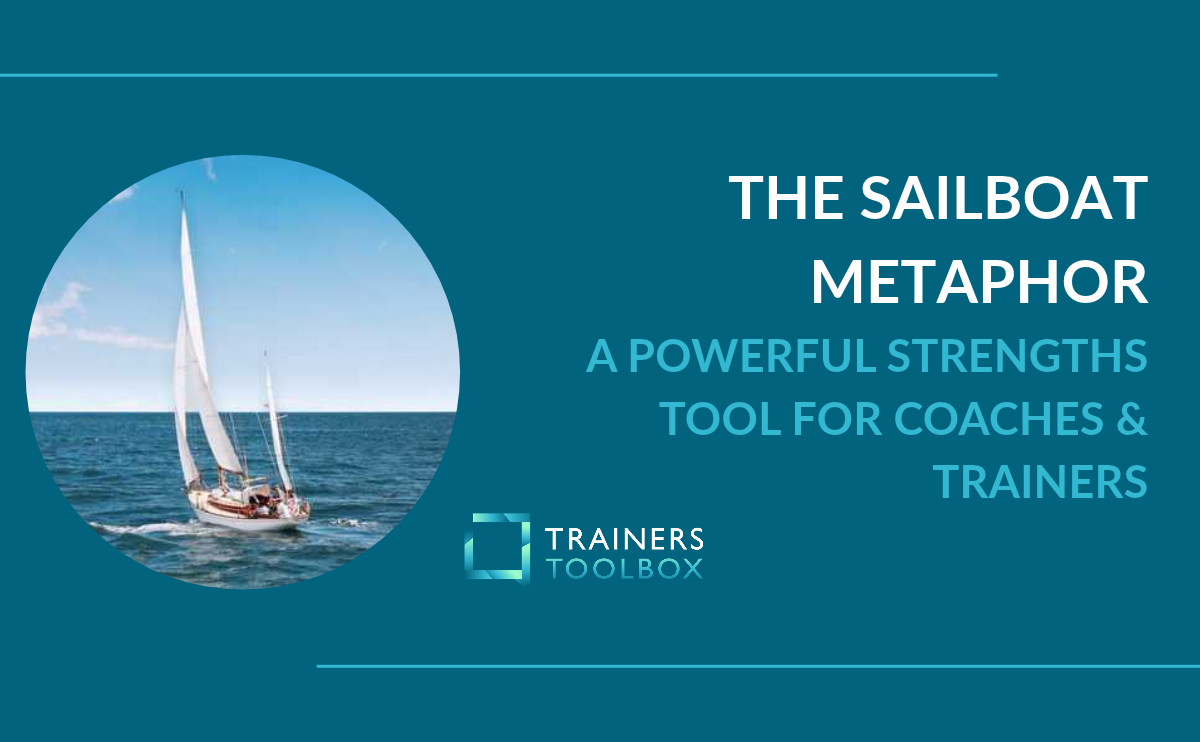
Picture yourself as a sailboat, moving through your life. You have a certain direction. Sometimes you choose it, sometimes the sea and the weather nudge you off course. But you keep moving forward.
As a boat, there are two important parts:
The hull is the body of your boat. And every hull has a few leaks. If you have ever been on a sailing boat, you know there is no such thing as a boat with no holes, no spots where a little water runs in. Those leaks are your weaknesses.
The sails are your strengths.
If a hole is big enough to sink you, then yes, you absolutely need to deal with it. You bail, you patch, you manage it enough to stay afloat.
But so many of us spend all our time down in the hull. Looking for leaks. Patching leaks. Checking for new leaks. Over-controlling the leaks.
And the sails sit there. Neglected.
Which is a pity, because the sails are the only thing that actually moves the boat.
What if, instead, you manage the holes just enough to stay afloat, and then put as much of your attention as possible on the sails?
Sails are where the energy is. That is where the fun is. When you use them, your performance soars and momentum and joy live there. Fix leaks all day and you won’t sink, but you float in one spot. Raise the sails and now you are moving forward.
I love using this metaphor even as a three-minute image. Introduce it, and people look at their strengths differently on the spot.
By strengths, I mean things like curiosity, empathy, a gift for structure, humour, calm under pressure, or a knack for connecting people. A strength is something you are good at and energised by. If you are good at it but it leaves you drained, that is more a learned skill than a true strength. (New to the concept of strengths? Explore our strengths-based approach article.)
A deeper way to use it: the full framework (the 8 elements of the sailboat)
You can stay with the simple hull-and-sails image and it will serve you well when working with strengths.
But the metaphor can also grow in many directions, depending on the goal of your workshop and how much depth and complexity you want to give it.
Once you are on the boat, you can name eight elements and use them as a richer framework for working with many aspects of life, wellbeing and performance. Each one opens a whole conversation, and it works beautifully in workshops as well as in coaching.
Here are the eight elements (you can also work with them in a different order, and use just the ones you pick instead of the full framework):
- Water: the reality and environment around you.
- Steering wheel: your needs, values and the meaningful direction you are taking.
- Destination: your goals and wishes, the map of where you want to reach.
- Leaks: your weaknesses, and your less effective ways of coping.
- Sails: your strengths, resources and the ways of coping that actually work.
- Compass: your emotions, feelings and intuition - your internal feedback on what is happening.
- Weather: the circumstances you cannot control.
- Other boats: other people on their own journeys - peers, collaborators, sometimes competitors.
I walk through all eight in detail in the podcast episode.
Let me show you how you could use each of these, using a few of the eight aspects as examples:
The destination: turning direction into real goals
A good place to start is the destination - our goals and the direction we are steering towards. This is one of the richest elements to explore, especially in coaching.
I usually start wide before getting specific, and combine it with different tools and frameworks for working on goals. Often I run a reflection using a framework known as ikigai, with a few questions on each of its parts: what you love, what you are good at, what the world needs, and what you can be rewarded for - and then we look at where they overlap. From there we move into concrete goals: a ten-year horizon, then three years, then one year (or whatever time frames fit the workshop and the person).
Other times I open with a mindset-stretching exercise first, something like the rocking chair (guided video), the ideal day, or the funeral speech, to loosen up big-picture thinking. Then we come back down into specific ten, three and one-year goals.
Either way, the destination stops being a vague wish and becomes something you can actually steer towards. Once we have explored it in depth (on a separate Miro frame or as a separate activity), we bring the main insights back to the central Sailboat board that holds the overview of all eight elements.
The weather: what you can and cannot control
The weather represents the circumstances you did not choose and cannot control.
Sometimes the weather is on your side, wind straight into your sails. Sometimes it is an unexpected storm, or simply some clouds on the horizon, or wind pushing you in the wrong direction.
In life, as in sailing, you cannot control the weather. But you can control two things: your direction (your values, the heading you choose to hold) and your response (which sails you raise, and how you handle the boat).
That is also where resilience comes from. We often use this part of the framework to explore resilience, dealing with stress, and building more mental strength. One way to define resilience is that it comes not from fighting the storm, but from adapting to it - while still holding your direction.
You can see how far this one element stretches, from resilience to managing stress, emotional regulation and the circle of control, depending on where it is most valuable to go for this person or group (and on the time you have).
Do you see how you could develop the other six elements in a similar way? This one metaphor can be used in many variations. It covers the majority of the topics we explore in goal-setting and life-design workshops and in coaching. And when you use the full Sailboat Metaphor (all 8 parts), you have it all neatly tied into a powerful, practical, strengths-oriented framework. One metaphor, many workshops.
(And if you struggle with how to develop the other six elements, or one of them is giving you trouble, let me know - I will prioritise exploring it more deeply in one of the next podcast episodes or blog articles.)
Taking it to a team: the captain and the fleet
Once your group is comfortable with their own boat, there are two directions you can take it even further:
One boat, or a whole fleet?
So far we have treated the boat as one person. But you can flex who the boat represents:
The boat can be the individual you are working with. It can be a whole team, sailing together, with shared sails and shared leaks. Or a team can be a fleet of boats, each person their own vessel, all heading somewhere together.
And the other boats around you can mean different things too. For an individual, they might be the people who send wind into your sails, or the ones who make the water choppier and steal your wind. For a team, they might be other teams, other departments, the wider world you are navigating alongside.
Same metaphor, different framing. You choose the one that fits your group and your workshop.
The captain: head, heart, gut and hands
There is one more part of the boat worth putting in the spotlight: the captain.
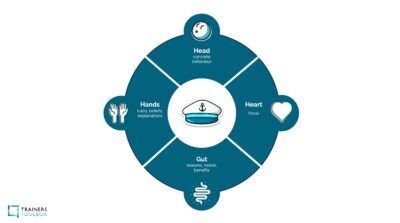
The captain is you, steering. I think of the captain as four parts working together: head, heart, gut and hands.
- Head: how you think. Where you put your attention, how you read the weather, whether your thinking works for you or against you.
- Heart: your emotions and values. What you care about, what matters, what you are steering towards.
- Gut: your intuition. The quieter knowing that reads a situation before your head has words for it.
- Hands: your action. What you actually do. Which sails you raise, when you hold course, when you adjust.
(In the original sailboat metaphor, Hugo Alberts frames the captain differently, as attention, action, motivation and thoughts. I use head, heart, gut and hands instead. It is simpler and more tangible, and I find people connect with it more easily and reach practical solutions faster. Read more about the sources and development of this metaphor at the bottom of the article.)
A good captain also knows which parts of the boat are theirs to control and which are out of their hands. And they walk a fine line: proactive enough to steer well and make the best of the circumstances, yet not so controlling that they wear themselves out fighting the sea.
The sailboat metaphor in practice: from a quick image to a full-day workshop framework
The amazing thing about this metaphor is that it scales from a five-minute image to a framework for a full-day workshop.
And if you choose to run a workshop, you can do it in two ways:
- Linearly: go through each element one at a time, as a step-by-step journey around the boat.
- Organically: start with the single element that matters most right now - maybe goals, maybe values, maybe resilience and challenges - and follow the conversation wherever it takes you from there.
Both work. Pick the one that suits your group and your goal.
A few questions to get a group thinking in terms of the boat:
- “Where in your work do you feel the wind in your sails?”
- “Which leak are you spending too much energy bailing right now?”
- “What is your destination this year, and is your steering wheel pointed at it?”
- “When the weather turns, what helps you hold your direction?”
Why metaphors work so well in workshops
One last thing, because it is bigger than this one boat.
If I walk into a room and say, “today we will talk about strengths, because strengths are good for your performance, your energy and your wellbeing,” I get polite nods.
If I say, “using your strengths is a bit like raising your sails,” and then open up the whole picture, I get a completely different response. People lean in with curiosity.
A good metaphor does two things at once: it wins you buy-in (people are suddenly curious and on board), and it brings clarity (the whole idea lands in one vivid picture instead of a paragraph of theory).
The science is still in the foundation of the workshop and woven into the content. The tools still find their place in the conversations. But the metaphor is what carries them in, wrapping them in a nice package with a bow on top.
So it is worth asking: where else in your work could a metaphor say more than a definition ever could?
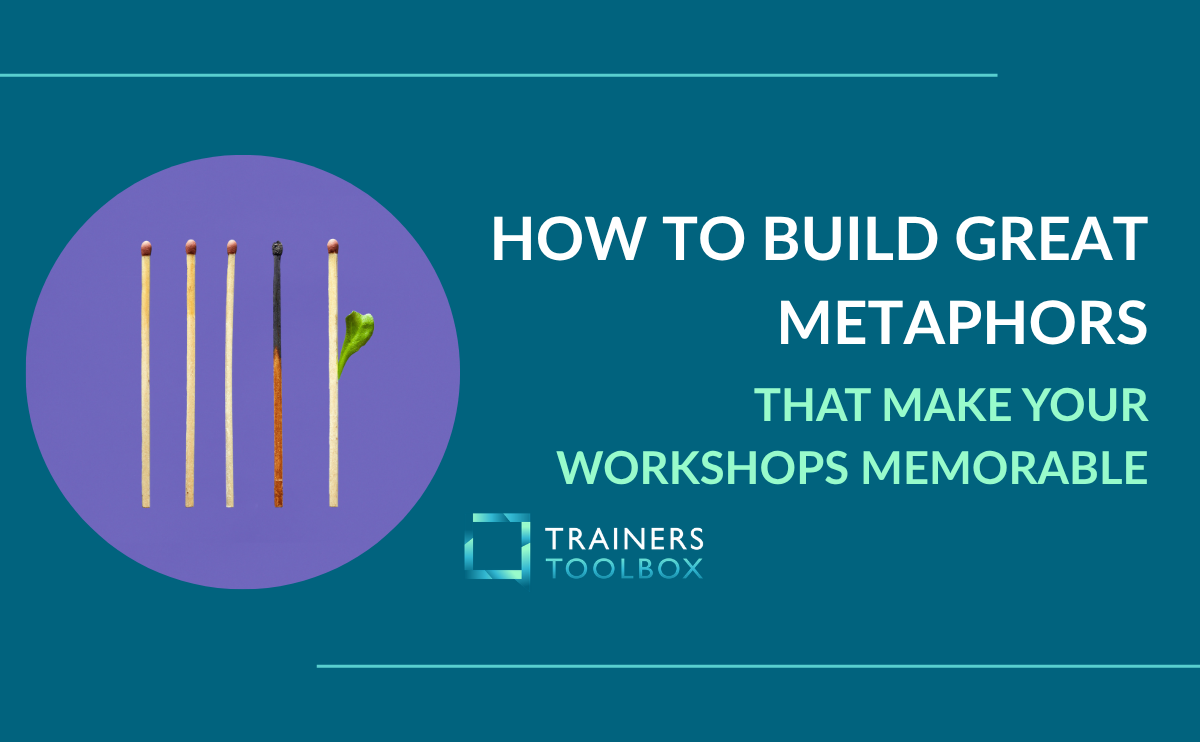
Discover more about the power of metaphors in workshops and how to use them
I wrote more about finding and using metaphors in your workshops here. There is a podcast episode on it too, if you would rather listen. And I have a Miro board with around 20 metaphors you can borrow for your own workshops (linked at the end).
Sailboat metaphors and resources like these are exactly the kind of tool we swap in Trainers Conversations, our small, cosy community of trainers and facilitators, where we test metaphors, images and tools like this one.
Further resources
A free Miro board to borrow for your own workshops: the board with around 20 metaphors - sign up here and you will get the link by email.
Free ebook: The Strengths Toolkit for Trainers and Coaches. A practical kit of strengths exercises you can use straight away. Download it here - free, just sign up.
Explore more about the strengths-based approach
Want a broader picture of working with strengths and more tools? Check out my strengths-based approach article.
If you would like to go further with mastering working with strengths, here is one way to do it with me: if you want to work with strengths and images in a deeper, more experiential way, I facilitate The Inner Journey course by metaFox - a three-day experience about learning to work with images, that dives right into working with your strengths.
And soon the sailboat will be one of the tools I explore in depth in my Positive Psychology Toolbox course, where we build a whole kit of strengths and wellbeing tools you can use straight away.
Source of the sailboat metaphor: Rooted in early strengths research by pioneers like Donald Clifton, the sailboat metaphor was formally introduced by Robert Biswas-Diener (2010) and later expanded into an 8-part framework by Dr. Hugo Alberts (2016). This work builds on that foundation, taking inspiration from Alberts’ core structure while introducing my own spin on the four elements of the captain. Shared with full transparency and gratitude to the positive psychology pioneers who inspired it.
About Mirna Šmidt
Trainer & facilitator with 18+ years of experience. Founder of Trainers Toolbox & Happiness Academy. On a mission to help trainers create deep, science-based learning experiences that actually stick. Let's connect on LinkedIn: https://www.linkedin.com/in/mirnasmidt/
View all posts by Mirna Šmidt