Trainer's Skills, Facilitation

The AI-Proof Trainer: 5 Deeply Human Anchors to Strengthen to Bulletproof Your Training Career in the Age of AI

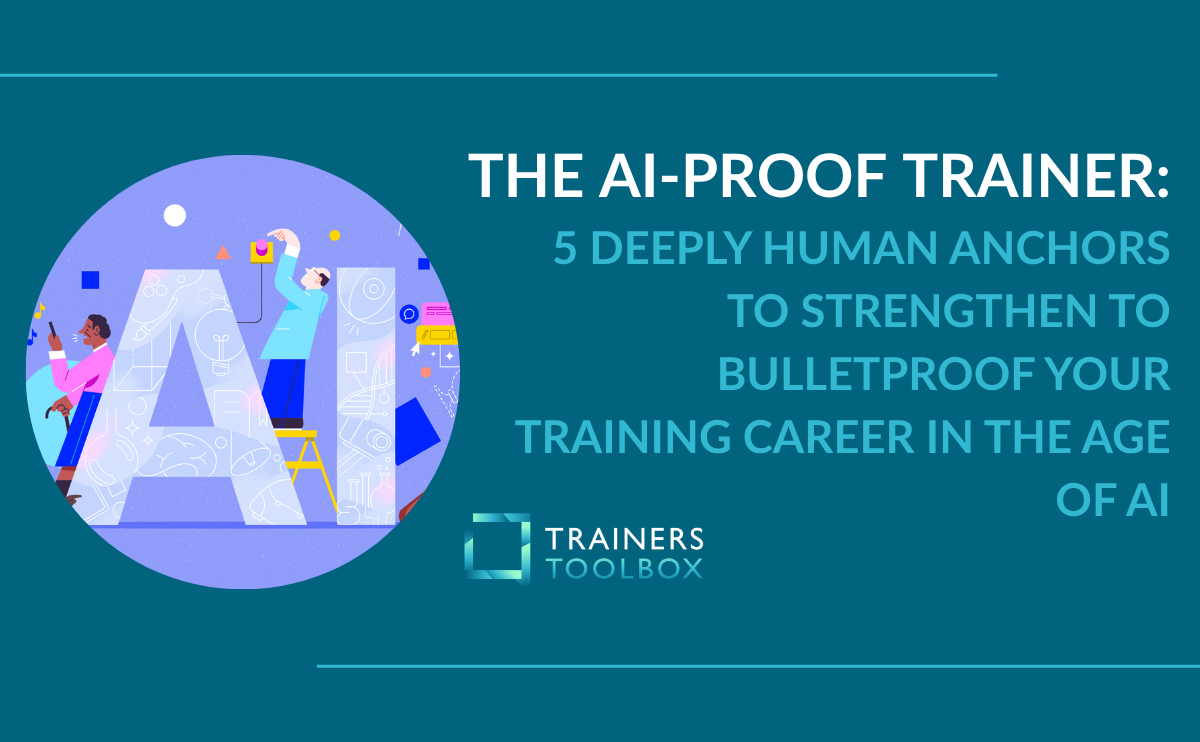
The Ai-proof trainers: 5 Deeply Human Anchors to Strengthen to Bulletproof Your Training Career in the Age of AI

The five deeply human parts of a trainer’s work that AI cannot replace, and a first step to strengthen each one today.

There is a lot of noise around AI in the training world, and all of it keeps revolving around two topics.

The first is loss: which parts of our job will AI take, and where might it replace us fully?

The second is leverage: how can we use AI to work faster, easier, better?

Both matter.

But how about putting the third topic in the spotlight?

One conversation we barely have, and it might be the most important one:
Which parts of our work are AI-bulletproof?
The deeply human parts AI cannot simply replace, and how we put them at the core of what we do?

This is what I keep coming back to: it is not really about AI at all.

It’s not about fearing it, fighting it, or racing it. It’s about putting our energy into the deepest, most significant parts of our work, and letting AI take over the parts we are happy to let go of.

Focusing on growing & improving the “deeply human” bits in our work will make all the difference, both in the impact we can create, and in the sustainability of our business or career as a trainer.

Here are 5 anchors that are deeply human parts of our work that stay ours and how you can start strengthening them TODAY.

(Did you know I also recorded a podcast episode on this? In it, I get more personal and talk about where I think our whole field is heading.
If you’d enjoy listening more than reading, discover it here: Ep.39 – Bulletproof Your Training Career in the Age of AI.
This article is the practical companion of that more visionary episode.)

The five anchors of “bulletproof” training, in the age of AI

To discover the parts of our work AI cannot replace, we need to ask the question: what are the deeply human bits of our work?

The answer is: Community. Live experiences. Reading the room. Driving implementation. Telling our own lived stories.

Here is each one, and where to start with building it:

Anchor 1: Community and real human connection

People are looking for human connection, sharing and exchange. That is something AI cannot provide.

A room of real people who have actually been there. People who will tell you what really happened. Not just about a workshop, but about their life, career and business as a trainer. The real successes and the real failures. The lessons learned directly from experience.

One of the most constant things I see: after people spend several immersive days together on a course, they don’t want to let that group go. That is actually how Trainers Conversations began. Alumni told me they had learned a lot, but what they needed next was time & space to put it all into practice, and they didn’t want to lose the supportive group they had found along the way. The community grew straight out of that.

Where to start: build a space where people meet. And this doesn’t have to mean starting a big new community. It can simply mean leaning more on connection in what you already do: making a bit more room for people to connect inside your workshop, letting them connect before it even begins, adding a few more moments of real conversation and sharing. Building that sense of belonging with a bit more awareness and intention in everything you run.

Anchor 2: Live, in-person learning experiences

When someone remembers a workshop months later, what do they actually remember? Almost never the content. Usually a moment. Something they felt.

Some things only happen when there is a shared physical space. The felt, in-person moments, the ones tied to real emotion, are the ones people carry long after the content has faded.

You can see it clearly at the end of Train the Trainer. The online part is solidly built, and still, when people finally meet for the final two live days, the shift in energy is something else. It is also why I designed the Treehouse retreat around rebuilding your vision and energy as a trainer: when people are put in a room together, in a beautiful space immersed in the forest, and the visionary part of them opens up in a way it rarely does on a screen. This is exactly why I pay so much attention to the physical environment I build each course in.

This is at the heart of designing an emotional journey that supports our learning journeys, to make learning deeper, more memorable, more transformational. Building emotional journeys is all about deciding, on purpose, how people should feel at each point. Not only what they should know.

Where to start: reflect on the two or three most emotionally memorable moments in your session, and how you could highlight them even more. Then design backwards from them.

(This is exactly what Emotional Journey Design is about, if you want to go deeper into it.
And for one specific piece of it, a highly recommended read: The Power of Moments by Chip and Dan Heath. It goes deep on one idea: how to build the peak moments people remember.)

Anchor 3: Reading the room and making the decisions

AI cannot feel a room.

It can help us a lot: with workshop design, brainstorming ideas, even warning us about traps we might hit. But it cannot have a feel for the people in the room. The colour of that room. The sense of the group, the subtle read of the energy, the emotions, and the context.

While AI is there to help you generate ideas, you are still often the one who makes the call: which idea truly fits this group, what to prioritise, and what to drop. It is up to you to be a visionary about what experience you are trying to build. That taste, judgement and vision stays yours.

There is also trust and psychological safety. For true change to happen, and for conversations to be truly transformational, people need to open up, get vulnerable, share for real and take real risks. That kind of space can only be created when a human is holding it. Not a machine.

So much of what we do on our courses runs on exactly this. On Train the Trainer, the conversations after a participant delivers an activity often go somewhere none of us expected, and that is where the gold is. Once, someone ran a light, playful activity that quietly felt unsafe to a few people in the room. The debrief turned into one of the richest conversations of the course: how easily a light, fun exercise can break someone’s sense of safety, when nobody in the room saw it coming.

Where to start: instead of focusing on content in your workshops, focus more and more on building this sense of connection, the physical space, and the ways we actually create the right context for meaningful conversations.
(If this is the muscle you want to grow the most it’s the whole heart of Advanced Facilitation.)

Anchor 4: From Knowledge to Meaningful Action

People can leave a workshop full of new ideas… only to change nothing on Monday.

We all know this: knowledge is one thing, and behaviour change is something else entirely.

Helping them actually put new behaviours into practice, in messy, real, varied circumstances, is deeply human work. It is support, accountability, and small nudges.

This is also the thinking behind everything we run at Trainers Toolbox. Our courses are built around your specific goals and your specific skills, as a customized journey with a lot of practice and feedback, so you leave with real experience, not just new knowledge. Because knowledge alone was never the hard part.

It is also why I put so much attention on follow-up. The Trainers Conversations community grew into a light way to keep that going after almost any course: one monthly call where people can extend their practice, keep learning, and get support from others while they actually implement. It will not be for everyone, or for every moment. But having a place to turn to when you need a bit more energy and support can make all the difference.

Where to start: add one accountability touch to your next programme. A check-in a few weeks later. A learning buddy. Think of ways to follow up with people that will support their learning even more.
(Ep.26, The 4 Keys That Turn Learning Into Real Change & Results, is all about closing that gap between knowing and doing.)
Knowing all this is one thing. Building it into how you actually work is another. So I put together a free 5-day challenge: one short email a day, one small step, to help you strengthen these anchors in your own practice. Doable, practical, and free.
BUTTON: Join the free 5-day 

Anchor 5: Your own lived stories

Here is one of mine. I trained as an engineer, so I am wired to be practical, to look for solutions and figure out how to make things actually work. But I also have a deep love of knowledge, which sent me digging into all the science under the hood of positive psychology. Add a strong pull towards adventure and a lot of intentionality in how I design my own life (something I talked about in my TEDx TEDxtalk), and you get the particular way I approach this work. Those three threads, the engineer, the researcher and the adventurer, shape everything I build, and they shape who it tends to resonate with.

AI can generate a story. It cannot generate your story: the lived, specific, slightly imperfect one that only you were there for, and the trust that comes with it.

But there is a catch. You need to know how to tell all of your stories. The significant moments and experiences in your work and life. Finding them, shaping them, and delivering them so they land is a craft in itself.

Where to start: capture one real moment from this week that could become a story. One a day, and you will always have a library of stories to tell.

(Start with Ep.11: The Trainer’s Guide to Storytelling in Workshops.)

Dig in deeper

Want to actually put these five anchors into practice, not just nod along? My free 5-day challenge walks you through one small step a day: Sign up here

Where is the world heading in the age of AI?

I’m really excited about where our field goes from here, and I get into it properly in the podcast episode, Ep.39: Bulletproof Your Training Career in the Age of AI. But here is the heart of it.

I really hope this invites us, as trainers, to take our work to a higher level. To move away from workshops that are a simple transfer of knowledge or insights, and towards designing real experiences. To focus more on emotion, on experience design, on turning every single workshop we run into something people actually live through, not just sit through.

That is the work that stays deeply ours. Not because we are running from AI, but because it is simply better work. And, almost as a side effect, it is also something AI cannot take from us.

Your turn. What human experience do you most want to create?

More ideas in the podcast

There are many more episodes where these ideas come from, full of practical thinking you can bring straight into your own workshops. Browse the whole Trainers Toolbox podcast whenever you want fresh input. And if an episode helps you, a quick subscribe, share or rating helps other trainers and facilitators find it too.

Want to take your work to a higher level?

If there are skills you still want to strengthen, I would love to invite you to join me for one of the deep learning experiences at Trainers Toolbox.

Everything we run is built to take your work to that higher level, so you become even better at designing impactful experiences and redesigning for behaviour change.

  • Train the Trainer: if you want the fundamentals, a strong foundation in designing and delivering learning experiences, this is a good place to start.
  • Advanced Facilitation: to get better at reading the room, navigating those live decisions and building trust, this is where you come in, train and practice.
  • Emotional Journey Design: a short course of three online modules that adds a lot to what you already do, on the emotional and experiential level.
  • Advanced Storytelling: to get even better at this human element, telling your own stories and making your workshops more engaging, colourful and immersive.

Not sure which fits where you are? Get in touch here or via Linkedin. I would love to help you figure it out.

author-avatar

About Mirna Šmidt

Trainer & facilitator with 18+ years of experience. Founder of Trainers Toolbox & Happiness Academy. On a mission to help trainers create deep, science-based learning experiences that actually stick. Let's connect on LinkedIn: https://www.linkedin.com/in/mirnasmidt/