Facilitation, Positive Psychology

3 Strengths Activities That Go Beyond the Reflection Sheet

3 Strengths Activities That Go Beyond the Reflection Sheet
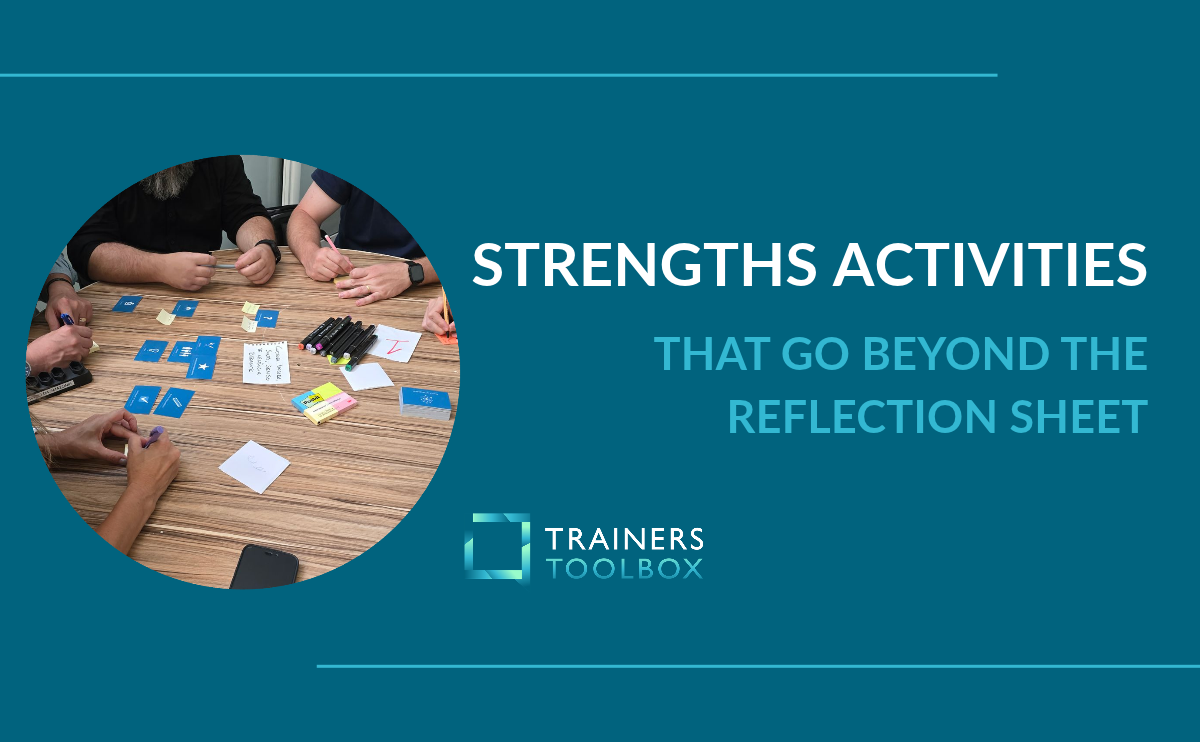
For trainers, facilitators and coaches who want strengths work to feel experiential rather than like another worksheet: three activities you can run with a group, including the steps, the debrief questions and what to watch for

When you are working with someone’s strengths, you can of course use self-reflection as a powerful method. (I have collected some great questions for exactly that purpose.)

You can also use an assessment (I explore 5 of the best ones in this article).

Or you can ask others for feedback, which is often the fastest route of all, because it goes right through the blind spots of strengths that we take for granted.

One more place that is always good to start is the sailboat metaphor.

But all of this reflection becomes far more engaging the moment people get to actually dig into their own strengths in an experiential activity, or work on strengths together as a team.

As always, the key to great workshops is versatility and a variety of exercises you can pull from. So here are three diverse examples, and an invitation to try them in your next workshop.

1. At Your Best

Pairs. 20 to 25 minutes. Paper and a pen.

Why this one is interesting: people are much better at remembering something they did than at describing who they are. Taking a slightly more indirect route into strengths also makes it easier for people to come up with ideas, rather than sitting in front of a blank page trying to summarise themselves.

Step 1: Individual reflection
Everyone lists their achievements and successes, alone, 5 minutes. Big and small. Anything they are quietly pleased about.

Step 2: Peer-to-peer storytelling
Each person picks one achievement and tells it to a partner as a story: the beginning, the middle, the end. What was happening, what they did, how it turned out. 5 minutes each way.

Step 3: The listener names the strengths
The partner listens for the strengths behind the story and feeds them back, with the moment attached: “When you described the part where nobody would decide, I heard perseverance, and something like fairness.”

Step 4: Swap roles
The listener becomes the storyteller, and you run steps 2 and 3 again.

Step 5: Capture it
Both write down the strengths their partner named for them.

Watch for this: invite the storytelling to be elaborate and very specific. This matters more than anything else in the activity. “I organised an event and it went well” gives the listener nothing to work with. Ask for the actual moments, the details, what was said, what was difficult.

Debrief question: Which of the strengths my partner named would I not have recognised in myself?

One thing I have noticed in the room is that people find it much easier to claim their strengths when somebody else names them first. And it simply feels nice to be recognised for the strengths you have.

2. Whose Strengths?

The whole group, 4 to 10 people. 30 minutes. Index cards. Great for teams.

Why this one is interesting: it is playful and it moves fast, and it shows people something the other two cannot: how they are seen by the group.

Step 1: Writing
Everyone writes their top 3 to 5 strengths on an index card. Anonymously, no names.

Step 2: Shuffling the cards
Collect them all and shuffle, so nobody knows what is coming.

Step 3: Reading out loud
Read one card to the group. The group guesses whose it is, and has to say why: what have they actually seen this person do that fits the strengths on the card?

Step 4: The owner responds
The person confirms or corrects, and can add how they see it themselves.

Step 5: Repeat
Keep going until the pile is gone.

Why it works: the guessing is what makes people give real, behavioural evidence about each other. That evidence is the actual content of the activity. The playful format is simply what carries it.

Watch for this: the group needs to have spent some time together. Strangers will guess randomly and the evidence will not really be convincing. In this activity, authenticity is everything.

My note from experience: what I really like is that this exercise can be used at different stages of a workshop. It can be a lovely warm-up, for a group to connect a bit more, or for a team before a deeper conversation. It can also sit in the middle of a team-building process, where people genuinely try to get to know each other better and dig deeper; in that version, combine it with the answers from the person whose strengths were named: how do they see it themselves? And third, with a small variation, it can be a nice closure, so that people walk away holding their strengths.

3. The Strengths Dial

Individual, then shared in the group. 20 minutes.

Why this one is interesting: it is not only important to recognise which strengths we have, but also how much we are using them, and whether we are sometimes overusing them. Honesty at 9 becomes bluntness. Kindness at 9 becomes “being unable to say no”.

Step 1: Pick a strength
Everyone chooses one strength they already know they have.

Step 2: Rate it 1 to 10
How much are they currently using it? 1 to 3 is dormant, 4 to 7 is the useful zone, 8 to 10 is overuse.

Step 3: Share the number
Each person says their number out loud in the group. Sharing it in front of others creates a bit more commitment, and along the way everyone learns more about each other.

Step 4: Explore the cost
Ask a few people whose strengths are at the extremes (high or low) what it costs them to use that strength at that level. The 2s and the 9s have very different problems, and both are real.

Step 5: One adjustment
Everyone names one specific situation this week where they will turn the dial up or down.

Optional variation for teams who know each other well: ask others to reflect back, or discuss in pairs, whether they see that strength showing up at that level, or more, or less. If you do this, it is important that the person whose strengths we are talking about owns the conversation. The final decision is always theirs. Everyone else is gently offering what they see, not correcting.

If people get stuck on their number: ask them which strength they usually get feedback about, or which one usually gets them into trouble. That will lead them to their number.

A note on safety, and please do not skip this one. This can become a vulnerable conversation. Someone may often be criticised or receive negative feedback about a strength they are overusing. And if you run the peer version, people may hear that others see quite different behaviour from what they think they are showing. So build a safe space before you launch into this, and be very clear with the group about what you are trying to build and what everyone stands to gain from it.

If you would like to explore this more, I have written about it in depth in the article Strengths Overused: When a Strength Becomes a Weakness, and talked it through in the podcast episode Strengths Overused.

How about exploring five more activities, with an explanatory video included?

I hope these three activities already gave you some ideas for working with strengths beyond the reflection sheet.

If you would like to dig deeper, sign up for the free 5-day email series. I did not want to make this article much longer and overwhelm you with options, so I am happy to offer more activities on a day-by-day basis instead.

In the series I cover different variations of exercises: some for individuals and some for teams, some very short and some that stretch over several weeks. Each one comes with a video, so you can see how it is actually set up and run.

Where to find more activities

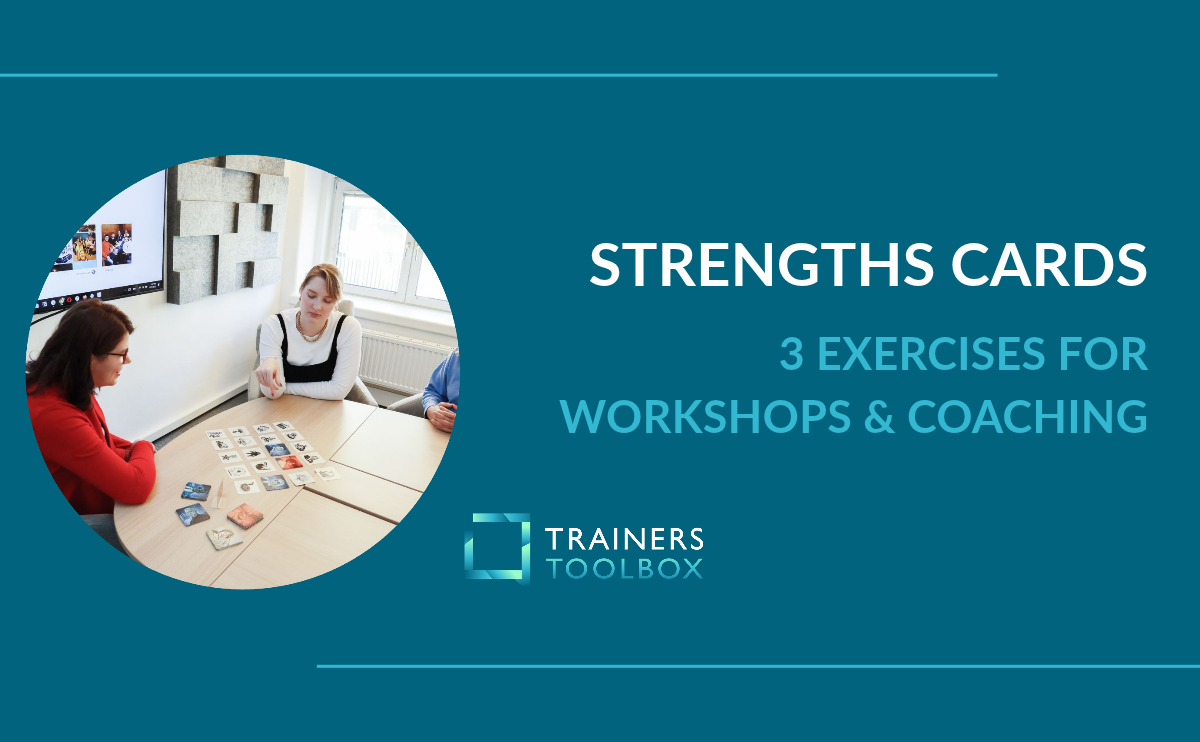
Explore some of the activities with card decks in my article on working with strengths cards.

I have shared many more strengths activities in a public library on SessionLab. It includes many strengths-based activities, but also others that go broader than strengths. Check it out here.

For the wider picture of how all of this fits together, start with the core article on the fundamentals of the strengths-based approach.

I also explore strengths often on the Trainers Toolbox podcast, including the episode Strengths Overused.

Looking to work with strengths in a deep, experiential way?

I facilitate The Inner Journey in Italy: 3 days working with emotions, images and strengths, built almost entirely on live practice. Day 3 is all strengths.

Or still looking for a group of trainers to think with all year?

The strengths-based approach is exactly the kind of thing we work through in Trainers Conversations, my year-round community of 22 trainers and facilitators. In 2027 I am also delivering a masterclass on the strengths-based approach inside the community.

Curious but unsure if it is the right fit? Get in touch via contact or LinkedIn.

So, which of these three will you run first, and with which group?

author-avatar

About Mirna Šmidt

Trainer & facilitator with 18+ years of experience. Founder of Trainers Toolbox & Happiness Academy. On a mission to help trainers create deep, science-based learning experiences that actually stick. Let's connect on LinkedIn: https://www.linkedin.com/in/mirnasmidt/