Trainer's Skills, Facilitation

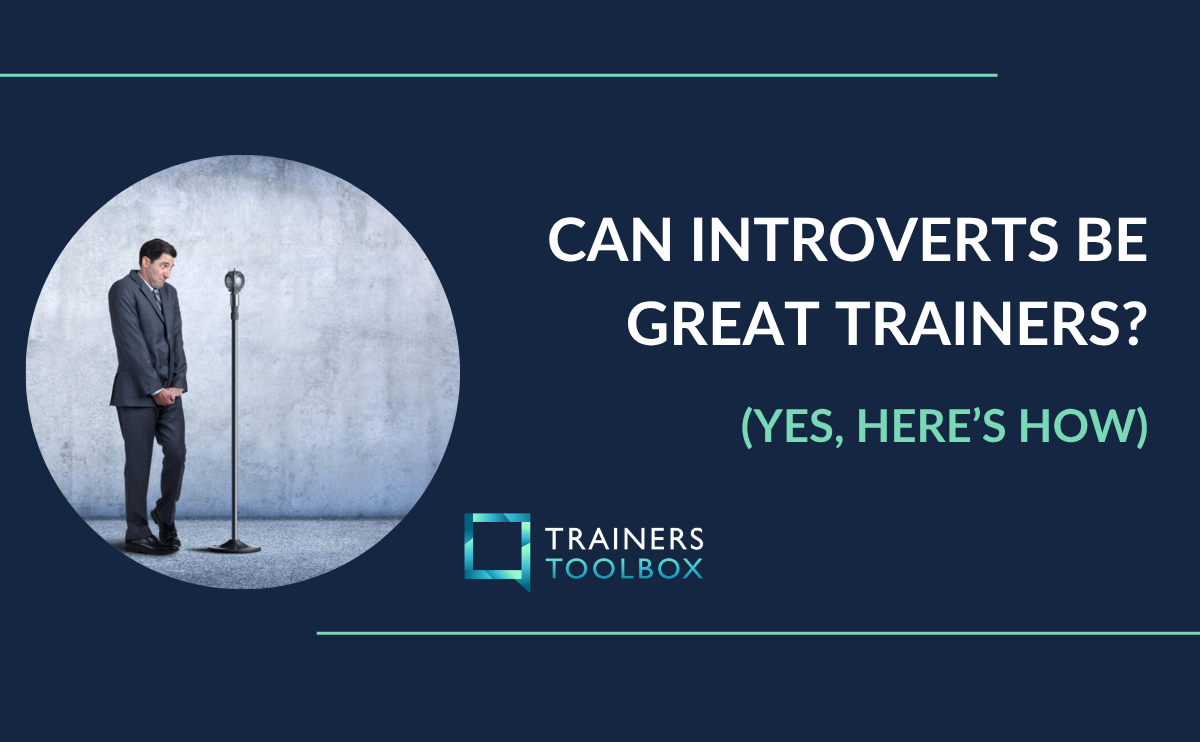
Can Introverts Be Great Trainers? (Yes, Here’s How)

Can Introvert Be Great Trainers.

You do not need to be loud to be a great trainer. For anyone who wonders if the spotlight is really for them, here is how to play to your strengths.

A participant in my recent Train the Trainer group asked me a question I’ve heard more than once now:

“Can you actually be a great trainer if you’re an introvert?”

The question surprised me a little.

Because of course it’s a yes. A wholehearted yes.

But then I realised that maybe, if you are an introvert who dreams of being a trainer, you might not be confident of this.

So let me share my experience, both as a trainer who leans quite strongly towards the introvert side, and as a trainer of trainers who has worked with some of the most amazing trainers who were, at the same time, introverts.

(If you’d rather listen than read, I share similar ideas in the podcast episode, with a few more questions and stories along the way.)

While I am also chatty and outgoing, in reality I am quite an introvert who highly values alone time and often feels cold pangs of social anxiety in many social situations.

My introvert side shows up primarily in two ways:
Time around people, workshops included, drains my energy fast, and I need real time alone to refill.
And I think far more clearly on my own than in the middle of a busy conversation.

Let me walk you through why introverts can be brilliant trainers, where your quiet can actually become an edge, and how to protect your energy so the work stays sustainable.

What actually makes a good trainer (it isn’t being loud)

Somewhere along the way we picked up the idea that a good trainer is loud. Outgoing. A bit of a showman. High energy from the first minute to the last.

Yet, this image of a trainer is as far from the truth as it could be.

Being outgoing can be a useful skill. So can a flair for entertaining. But neither is on the list of things that actually make training work.

What are the things that make training truly work?

Here is what matters way more than how outgoing and engaging the trainer’s personality:

Strong design: a clear goal and a structure that takes people somewhere.

An understanding of how learning happens: being intentional about when to diverge and when to converge, protecting time to reflect & digest insights, creating space to debrief, building an experience worth having where trainer is a guide and participant is a hero.

Listening & adapting: reading the room and responding to it, instead of pushing your own agenda.

Good questions: the skill of asking the one that opens things up.

Psychological safety: building a space where people feel secure enough to actually learn.

Look at that list again.

Not one item asks you to be the loudest voice in the room.

And several actually come more naturally when you’re not.

Where being an introvert is actually an edge

And guess what? Some of the things that make you a strong trainer are things introverts tend to do well by default.

You think things through.

Introverts often prepare more deeply and think to more depth. You’ve turned the design over in your head, considered the edge cases. That thoughtfulness shows up in your training room.

You’re comfortable with silence.

So many trainers rush to fill a pause, when the pause is exactly where the learning happens. Introverts tend to be more at ease leaving space, letting people sit, think, and arrive at their own conclusions. You are also more likely to allow people the space to reflect, digest, integrate, and come up with their own answer, and it deepens their learning.

You communicate on purpose.

The old idea that introverts aren’t good communicators has it backwards. Speaking less often means speaking more intentionally. You choose your words, and are less likely to overwhelm participants with too many ideas thrown at them.

You listen better.

When you’re not filling every silence, you notice more. The shift in someone’s posture. The quiet participant with something to say who hasn’t said it yet. The thing the group is avoiding. Good training runs on noticing, and noticing is a listener’s game.

None of this is a hard rule. Extroverts do all of these things too. But if you are an introvert, this might be one of your best tools and a natural gift.

The real challenge isn’t your personality. It’s your energy.

Now, this is the important aspect. If you are an introvert, please don’t overlook this one.

Being an introvert trainer does mean taking your energy seriously, because a full day of holding a room takes more out of us than it takes out of a natural extrovert.

Ignore that, and you burn out. Respect it, and you can do this work for years.

So here is the playbook I use:

Arrive early and land

I show up around an hour and a half before a workshop. Not to rush around, but exactly the opposite. To settle. To let my thoughts organise themselves, arrange my materials, make the space mine. That early time means my first moment in the room isn’t an immediate conversation with staff or participants. It’s me, creating my space. It changes how grounded I feel when people arrive.

Guard your breaks, gently

Breaks are where your energy comes back, so protect them. The tricky bit: a participant catches you with a question, and suddenly your recharge time is gone. It’s fine to hold that boundary. Just remember to hold it kindly. I once trained alongside someone who was firm about his breaks but not gentle at all, practically putting his hand up in people’s faces. Don’t be that. “I’d love to get into that, let me grab a few minutes first and come find you” protects your space and the relationship at once.

Your evenings belong to you

After a full-day workshop, I don’t socialise. Full stop. I’m sometimes tempted, and it’s always a mistake. So now I’m clear, with myself and with others, ideally in advance: the evening is mine to recharge, and it has nothing to do with how much I enjoyed the group. Say it kindly, say it early, and hold it.

Breathe

Breath is your quickest way back to yourself. A few slow, deep breaths before you start, before a high-energy stretch, or any time you feel your energy dip. Long exhale especially. It pulls you back into your body and takes the edge off. It sounds almost too simple. It works anyway.Breath is your quickest way back to yourself. A few slow, deep breaths before you start, before a high-energy stretch, or any time you feel your energy dip. Long exhale especially. It pulls you back into your body and takes the edge off. It sounds almost too simple. It works anyway.

Shape your formats and your business around your energy

Notice when your energy dips during a day, and design around it. Notice, too, what kinds of work actually suit you. Maybe not full days back to back. Maybe not full-day virtual (I never do those). Maybe smaller groups feel best.

This shows up in your business model as well. We’re often better off not running “busy” workshops every single day, but protecting the depth and value of what we offer, pricing it properly, and leaving room to prepare and recharge between. So stop thinking of it as a limitation, and start thinking of it as good design.

Plan your recovery

If you’ve got something big coming, a multi-day event, a retreat, a run of workshops, decide in advance where your recovery goes. I protect the day before and the day after. For example, for a retreat like the Treehouse, I arrive early and keep the day before free of any non-essential conversation. Everything that can be ready is ready ahead, so I’m not draining myself right before I need to be at my best.

And about those nerves

If being the centre of attention makes you nervous, two things help (maybe this is also a topic for another article? Let me know here if you would like me to write more about it):

First, take the focus off yourself and put it on them. You’re not there to look smart. You’re there to help these people understand something. Shift your attention from “how am I doing?” to “what do they need?” and a surprising amount of the fear quietens down.

Second, breathe. Again. The difference between anxiety and excitement is mostly breath. Both come with that jittery, adrenaline energy. But excitement breathes deep and open, while anxiety clenches and holds. So open your chest, stand a little taller, and breathe, with a long exhale.

You can actually talk your nervous system from anxiety into excitement.

Your quiet is not the problem

You don’t need to become louder. You need to become more you, on purpose. Build on what you’re already good at. Protect your energy like it matters, because it does. And let your quiet be the steady, grounded presence a room can trust.

Looking to keep developing your skills as a trainer?

If you want to build the craft underneath all of this, the design, the structure, the reading of a room, that’s the whole of Train the Trainer It’s the programme that gives you everything you need to be a really good trainer, quiet or not.

Or still looking for your community – one where introverts can thrive?

Prefer to think out loud with people who get it?

Trainers Conversations is a small community talking through exactly these topics: energy, personality, the craft, the business. We meet online once a month, and it’s all about connection and meaningful conversations.

One book to leave you with: Quiet by Susan Cain, on introversion as a strength. It’s part of my full booklist of favourites for trainers, which you can grab here.

The Ultimate Booklist for Trainers & Facilitators

So, one last question to sit with: which part of your quiet will you stop apologising for?

author-avatar

About Mirna Šmidt

Trainer & facilitator with 18+ years of experience. Founder of Trainers Toolbox & Happiness Academy. On a mission to help trainers create deep, science-based learning experiences that actually stick. Let's connect on LinkedIn: https://www.linkedin.com/in/mirnasmidt/