Storytelling, Brain-based Learning

How to Build Great Metaphors That Make Your Workshops Memorable

How to Build Great Metaphors That Make Your Workshops Memorable
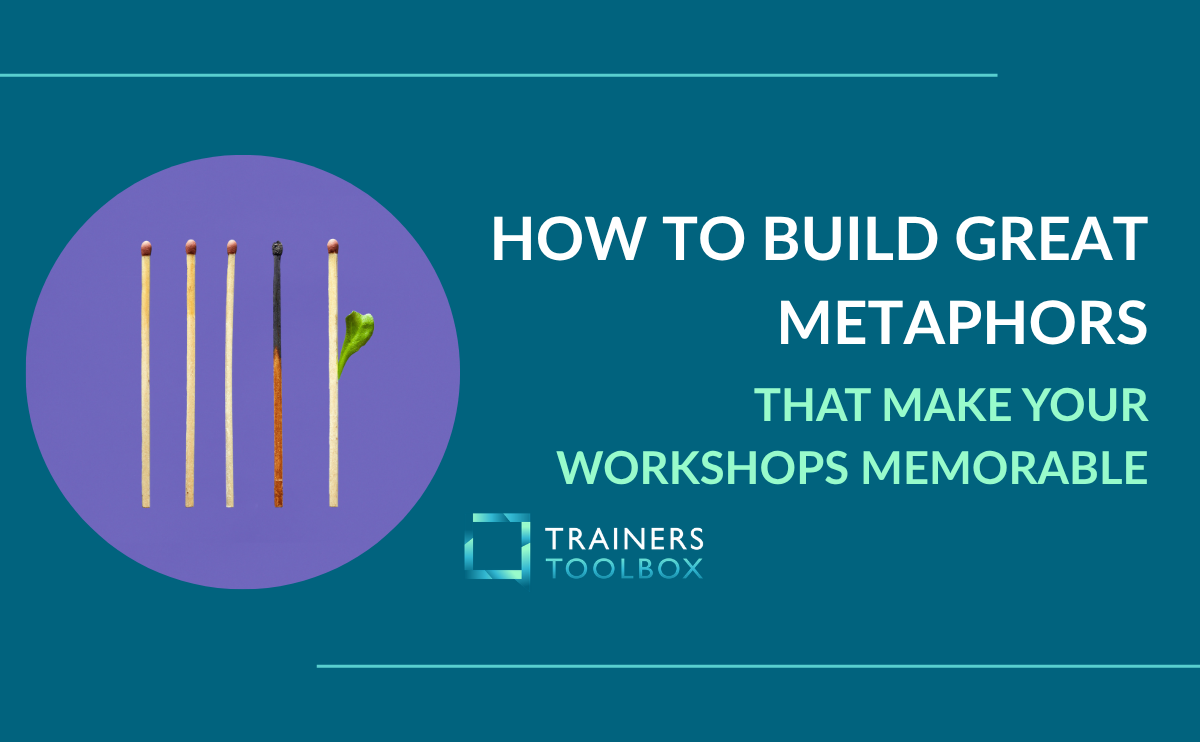
For trainers & facilitators who want abstract ideas to land, stick, and turn into action, using powerful and colorful metaphors.

You can’t see the forest from the trees.

Keeping them focused today was like herding cats.

You can’t grow a muscle by reading about push-ups.

Such short, simple sentences – yet such powerful, clear images!

When the plain words feel flat, we often reach for a picture… and suddenly the idea has colour, shape, something you can almost touch.

Metaphors are powerful. They make a complex idea simple, a dry concept memorable, an abstract point something people can feel.

And it makes them one of the best tools to incorporate in our workshops. 

Often, we reach for metaphors on instinct. A good image simply shows up in our mind.

But the shift I want to explore with you is this: you can build them on purpose. You can also start building your “toolbox” of your favorite metaphors.

And once you do, metaphors stop being a happy coincidence and become one of the most useful tools in your kit.

So let’s look at how a good metaphor for a workshop works, how to build one, and a few of my favourites you can borrow straight away.

Why metaphors work so well in training

A metaphor builds deeper understanding because it takes something the person already knows from everyday life and attaches that same understanding to something new and abstract.
For metaphor to land well, it needs to be:

  • Concrete & visual: people hold on to a picture far longer than a definition.
  • Simple: a good metaphor turns a complicated idea into one clear image.
  • Emotional: images spark imagination and feeling, and feeling is what makes learning stick.
  • Shared: once a metaphor lands in the room, it becomes a shortcut the whole group can use.

The interesting question is: how do you build such a metaphor intentionally?

How to build a good metaphor

A metaphor either clicks or it confuses.

The difference usually comes down to a handful of choices:

Start from something they already know

The whole magic of a metaphor is that it borrows understanding. So the source has to be something your participants are already familiar with, ideally something physical and everyday. A garden. A road trip. A muscle.

If it’s a risk it’s unknown to them, or the metaphor itself needs to be explained, it doesn’t really work. The more ordinary the image, the better it works.

Match the structure, not just the picture

A metaphor is not “these two things are both nice.” It works when the relationships line up.

Take “learning is like a seed.” It is not a good metaphor because seeds are pretty. It is good because a seed needs time, attention and care to grow, and so does a new insight. When the parts map onto each other, the metaphor creates that new understanding.

So once you pick an image, take a moment to reflect on its structure and how both of these things really work. Are they really parallel – or it just seemed so?

Make it something they can see

Don’t tell people “this concept is foundational.” Show them a house. “Skip the foundation and it does not matter how beautiful the rooms are, the whole thing shifts and cracks.” Suddenly “foundational” has a weight you can feel.

The more senses your image touches, the deeper it goes. (This is the same reason sensory detail makes a story land. I wrote more about that here: The Quickest Way to Make Any Story More Memorable)

Know where it stops

A metaphor is a tool, not a theme for the whole day.

It is tempting, once you have found a good one, to stretch it over everything. “And the clouds are your limiting beliefs, and the rudder is your values, and…” Don’t. The moment you are forcing details to fit, people feel the strain and the magic leaks out. And it gets boring really fast.

Make your point, let the image land, then move on. You can always refer to it once or twice when useful, but be mindful not to overdo it.

Let it become shared language

This is the quiet superpower.

Once a metaphor lands, the whole room can use it as shorthand. “Remember to water your seeds this week.” “Are you rushing to the peak?”
A single image becomes a shared symbol the group returns to, long after the workshop ends. And shared symbols help people to keep coming back to the concept. (This is especially powerful in groups that are not just joining the workshop but will be working together for a longer time ahead). .

So when a metaphor works, name it, repeat it, and nudge the group to make it theirs.

Example from practice: Three metaphors I keep coming back to

There are many metaphors I use in training, so here are 3 quick examples (you can discover many more examples at Miro board with Metaphors – signup for it here).

Notice how each one leans on the principles above: an everyday image, a structure that maps, something you can see.

Metaphor example 1: Pathways in the brain - for new habits & mindsets

As I work with positive psychology and with learning, and re-shaping the brain is at the center of both of these topics, this is one of the metaphors that I use most often.

Here is how it goes:

Pathways (of our common thought patterns) in a brain are often just like pathways in a forest:

There are some that we take often, and these are well-trodden. They might even not be just a path, but almost a highway! It is easy to go down that path, and it is fast, we almost don’t even notice and we are already half way down that path.

On the other hand, paths that we don’t use often are all covered in weeds, hard to notice and not really cozy to walk on. Almost like fighting your way through the jungle…

The first time we walk down that new path, it won’t really feel good. It won’t feel comfortable, and we might feel like we don’t know where we are going.

Yet, the more we pass on it, the more developed that pathway becomes. The easier it gets to go there…. And more and more enjoyable.

How many times do I have to pass down the new path to make it strong? I have no idea.. There is not a single number… but for sure it’s more than 10 times and less than 100 times.

And the old highway, that one never really fully disappears. While it gets a bit more weedy, it is still easy to split down that path… so the important practice is to keep on walking down the new path, and keep strengthening that one, until it becomes even stronger than the highway.

(And maybe I will add here an example: maybe the highway is our old habit of complaining, and the new path is the path of gratitude… or depending on what we are working on in this workshop).

I use this a lot in mindset work, when someone is trying to build a new habit or shift an old attitude.
And especially in positive psychology topics, where so much of the work is about practising new patterns of thinking or small new habits that have a big impact.

Metaphor example 2: The mountain - for goals & balance

It’s a beautiful sunny weekend, and you are going for a hike.
When you reach the mountain, there are three ways you can approach this hike:

First: Fix your eyes on the summit and rush, head down, pushing hard. You are aiming to reach the top, and don’t really care for what is on the way. You don’t stop for the views, are breathing too hard to chat with your friends, and ignore the pleasure of the walk and the nature. When you reach the top, you have a moment of satisfaction over the achievement you just did – but it wasn’t really an enjoyable day for most of it.

Second: You are just going to enjoy nature and don’t really care about the peak. You wander around aimlessly, enjoying pretty views and smelling the flowers. It is a relaxing day… but at the end of it doesn’t feel very meaningful, not satisfying.

The third option is what for most of us at most occasions, is a good hike – and it holds both: a clear peak to aim for, and enjoyment of the path.

Goals work the same way, and this is such a great metaphor to use when talking about life design, setting everyone’s goals, wellbeing, and how to approach achievements vs enjoyment balance in life.

So, when we talk about the goals, I will bring this metaphor in right at the beginning and later might ask a group: are you rushing the peak? Or have you lost sight of it altogether? Is this the balance you are looking for?

It might also be a great metaphor to bring when talking about burnout, energy management, and what makes life meaningful.

Metaphor example 3: Planting seeds - for follow-through

Every idea, insight or aha moment in a workshop is a seed.

It holds real potential, to grow into meaningful change in someone’s life or work. But a seed is only a beginning. If we walk away and never return to it, it dries up. If we give it attention, reflect on it, come back to it and act on it, it takes root, and real growth begins.

I use this one at the very end of a training or coaching process, when people have their action plans in hand.

It shifts the focus from the bright moment of insight to the slower, realer work of follow-through.
And it works just as well for a personal goal as for change across a whole organisation.

The line I leave them with: What will you do this week to water your seeds?

There is one more I love, the sailboat, for a strengths-based approach, both for how we work with our own strengths and how we notice them in others.
But that one deserves its own article, so I will give it the room it needs soon.

And if you would like a few more, I walk through those in the podcast episode on metaphors and share it in the Miro board that you can access by signing up in the form a bit up in this article.

Before your next workshop

A metaphor is one of the simplest, most powerful tools you can add to a piece of training. So before your next one, a couple of questions worth sitting with:

What idea in my next workshop is abstract enough that a picture would help it land?

What is one everyday thing, a garden, a journey, a tool, that already holds the shape of that idea?

Then build it. Start from something familiar, check that the structure maps, and make it something they can see.

Keep exploring the world of metaphors

When I was putting together the podcast episode on metaphors, I gathered a whole Miro board of 15+ ready-to-use metaphors for workshops. Each one comes with what it is good for and when to use it. It is yours, free.

And if this lit something up for you, metaphors are one small corner of a much bigger craft. In the Advanced Storytelling course for trainers & facilitators, we go deep into finding, building and telling the images and stories that make your training unforgettable.

You might also enjoy two related reads:

Two more ways to make an idea land and stay.

Curious whether the course is the right fit for you? Get in touch via contact or Linkedin, and we can explore it together.

So: which metaphor will you try in your next workshop? Build one on purpose, and watch what it does to the room.

author-avatar

About Mirna Šmidt

Trainer & facilitator with 18+ years of experience. Founder of Trainers Toolbox & Happiness Academy. On a mission to help trainers create deep, science-based learning experiences that actually stick. Let's connect on LinkedIn: https://www.linkedin.com/in/mirnasmidt/