Brain-based Learning, Trainer's Skills

Brain-Based Learning: 6 Tips to Make Your Workshops More Memorable

Brain-based Learning - tips to make your workshops more memorable

How to stop overwhelming your participants, hold their attention, and make sure the key points actually land.

Did you know that a workshop where everyone is engaged, laughing, and nodding along can still leave your participants remembering almost nothing a week later?
It’s one of the most common (and quietly destructive) blind spots for many trainers, facilitators, and speakers.

You do a great job in the room, and still, so often the content doesn’t quite stick.

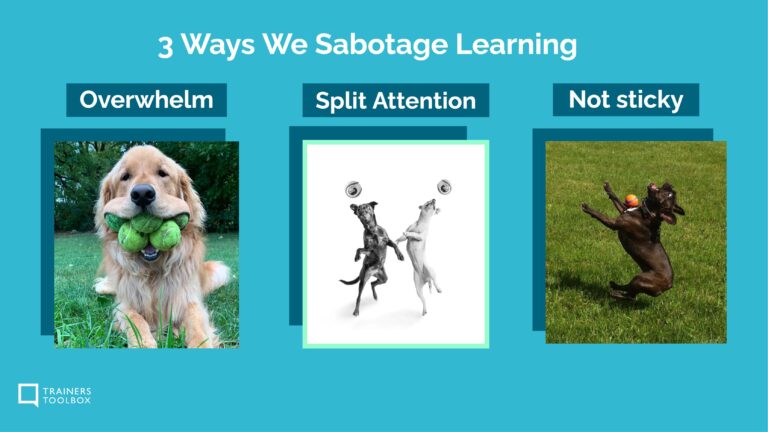
Today, I would like to explore with you three traps that quietly sabotage learning (and which is why often participants will remember so little of your workshop).
And I would love to share 6 brain-based tips that are the solution to avoiding these sneaky traps.

How to gain most value out of this article?

To make sure you get the most value out of this article, I would like to invite you to approach this article with the most productive mindset:

instead of thinking “Sureeee, I know everything” and then making no progress in making your workshops even better, or instead of asking “Am I doing this wrong or right in my workshops?”, ask “How could I be doing this even more/better?”

Even if you already do these things, doing them more (more often, better, or more consistently) will make your workshops deeper.

Ready? Let’s go.

3 traps of brain-based learning

Prefer to hear this in Mirna's voice or in a simple video? Listen to Episode 32 of the Trainers Toolbox Podcast: Brain-Based Learning for Trainers. Available on:

Trap 1: Overwhelm - Creating Overwhelm by Adding Too Much Content, or Moving at a Pace Too Fast for Mental Processing

We can’t help it. We know a lot about the topic. We want to give value. We want people to leave with as much as possible. So we add one more slide, one more nuance, one more example, one more story to bring it home.

But at some point, more stops being more valuable. The brain hits its limit, and everything after it just slides off.

Here are two moves that enable you to add value (and more content) without tipping into overwhelm:

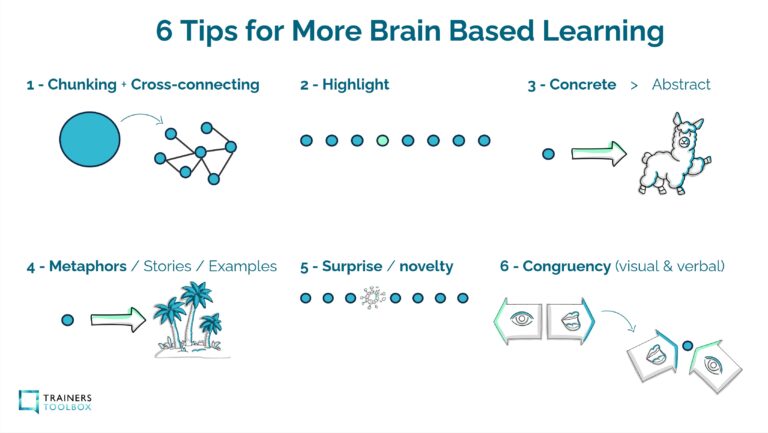
Tip 1: Chunk and Cross-Connect

Take every big piece of content you plan to teach and ask:
Can I break this into smaller, more digestible parts?
Can I split it into three steps instead of one?
Can I turn it into a model with parts that connect?

Smaller bits are easier to take in. They are easier to remember. And if a participant loses one bit, they still keep the rest. If you deliver everything as one big block and something slips, they lose the whole point.
But chunking on its own is not enough. Once you break content into modular pieces, you also need to cross-connect them. Tie them together. Refer back to earlier bits as you introduce new ones. Drop small teasers for what’s coming next. Keep the bridges between the pieces visible.

Think of your content bits as islands, and cross-connections as the bridges between them. Build many bridges, not one. If they lose that one connection, or miss one of the islands, enable them to still keep others within their reach.

Tip 2: Highlight Most Important Things

Some overwhelm will happen. You cannot avoid this: people have diverse capacity, preknowledge, attention span. And because of it, some information will slide off. That is normal.

What matters is that the most important points do not slide off with the rest.

So be very clear on your priorities. Pick them carefully. Two, maximum three points per workshop that you truly want to make sure everyone gets.

Then protect them. Highlight them. Make them stand out from everything else you cover.

A few ways to highlight the most important points – make sure to use these intentionally, for points that truly matter the most:

  • Voice: slow down, speed up, pause a little longer, get quieter, get louder. Whatever contrasts with your normal rhythm.
  • Visuals: pair the key point with one clean, catchy image that puts it forward.
  • Words: “if you only take one thing away from today, this is it.” Reserve this for one or two moments in the whole workshop so it doesn’t lose weight.
  • Curiosity first: ask a question before you give the answer. Let the brain reach for something before you hand it over.
  • Repetition with variation: come back to it later, phrased differently, so it lands twice without feeling like a summary.

The temptation is to think everything matters. But if everything is important, nothing is! So make sure to choose what really matters.

Trap 2: Split attention - Creating Conflict Between Auditory and Visual Channel, or Overwhelming/Underusing One of Them

Attention is volatile. It slips away easily. We know this. We all experience it every day, both with our learners and in our everyday life.

What we underestimate is how often we cause the split ourselves.

The brain has two channels for taking in new information: visual and auditory. Both are running the whole time you speak. For learning to work well, both channels need to be stimulated but not overwhelmed. And both need to support the same insight (instead of conflicting).
The most common way we cause attention splits when sharing information with others is by creating a mismatch between what people are hearing and what they are seeing, or by leaning too hard on one channel (auditory or visual) while leaving the other one underused (and bored).

Here is what it looks like in practice when you align them poorly:

  • You are talking fast about a rich concept, but the slide behind you is empty. The visual channel gets bored, and attention drifts to the ceiling, the window, someone’s shoes. At the same time, the verbal channel struggles to follow.
  • You put up a slide crammed with text, then start explaining something slightly different (or just one small bit of that complex slide). The visual channel is trying to read while the auditory channel is trying to listen, and you never know which one will win. But for sure they won’t work in an aligned way!

When the two channels aren’t aligned, attention is dispersed and participants don’t really learn.

Tip 3: Align Your Visual and Verbal Channels

This principle has a name in brain-based learning: dual coding.
When your visual and verbal information support the same learning point, memory doubles up. When they compete, memory drops.

One more example of where the split creeps in without us noticing: you reveal all four steps of a process at once, then try to explain step one. Their eyes are already on step four.

The solution is using both channels in a congruent way.

Picture your voice and your slide as two dancers on the same stage. When they move together, in the same rhythm, telling the same story, the audience is captivated.

Practical version: one slide, one point, one image. Reveal the next step when you’re ready to talk about it. Keep visuals simple enough that they support what you say instead of stealing the show.

Tip 4: Re-Engage Attention Instead of Trying to Hold it

But please don’t feel under pressure!
Because, you see, you do not need to hold your participants’ attention for 100% of your workshop. That is not how the brain works. Nobody’s attention can be held for hours in one go.

The real skill is re-engagement. Let attention drift when it wants to. But make sure to bring it back before the most important points, and to make it easy for people to get back on board, even if they lost attention for a moment.

There are many ways to bring attention back. One of the fastest is surprise. Novelty. Something the brain didn’t expect. Our brains are evolutionarily wired to react to novelty, because that is where opportunities and dangers live.

Surprise doesn’t need to be big. It can be:

  • A visual that changes suddenly.
  • An unexpected question thrown into the room.
  • A small trivia moment. “Did you know…?”
  • A change of pace or format. From standing to sitting. From talking to silence.
  • The three-word signal that resets everyone’s brain: “Let me tell you a story.”

Use surprise deliberately. Reach for it just before your most important point, so attention is fresh when you share that important point.

Trap 3: Non-Sticky - Not Making Content Memorable and "Easy to Stick"

You designed it well. You delivered it well. People were engaged. People were curious. People had fun. And still, a week later, they can’t tell you what they learned.

This is the phrase I want you to keep in your mind at all times when designing and delivering your workshop:

Content covered is not content learned.

What does that actually mean? Covering the content is your side of the equation. Learning is theirs. Just because you said something in the room does not mean it left the room with them. If the brain didn’t grab the idea in a way that lets it be retrieved later, it wasn’t really learned. It was heard, and then it evaporated.

Here are the final two brain-based tips for today, to ensure we give the brain something to grab onto.

Tip 5: Use Concrete Words, Not Abstract Ones

The brain remembers what it can visualise. Abstract concepts slip through. Concrete, sensory words stick.

Look at the difference:

  • “Foster psychological safety.” vs. “Make it feel safe enough for someone to say the messy first thing that comes into their head.”
  • “Optimise your feedback loops.” vs. “At the end of each activity, ask them one question. What did you notice?”
  • “Enhance participant engagement.” vs. “Watch for the moment three people in the room lean forward. That’s your signal to go deeper.”

The concrete versions are a little longer. They are also memorable. The abstract versions sound smart in the room and disappear from everyone’s mind the moment the door closes.

Whenever you catch yourself using an abstract concept, ask: What does this actually look like, sound like, feel like?

Then use those words instead.

Tip 6: Reach for Metaphors, Stories, and Examples

If concrete words are the fastest fix, metaphors, stories, and examples are the deepest fix.

They do three things at once:

  • They make it simple. A metaphor gives your participants something they already know, so the new idea (the new “island”) has somewhere to connect.
  • They make it vivid. Something with an image, a sound, or a smell attached is far easier to recall than a bullet on a slide.
  • They bring in emotion. Especially stories. And emotion is one of the strongest glues the brain has.

Reach for a metaphor when you feel yourself explaining the same idea in a loop. Reach for an example when the concept is getting too general and abstract. Reach for a story when the moment matters and you want it to be remembered – or when you want them to connect to the point more personally.

Don’t overcomplicate your life – play it simple. A short, clear metaphor that fits beats a clever, layered one that impresses. The goal is stickiness, not sophistication.

(You would love to add great, captivating stories and anecdotes to your workshops, but you are not sure how? Join me at Advanced Storytelling Training to train it together.)

6 tips for brain-based learning

How to put this into practice

Six tips can feel like a lot. Please don’t try to do them all at once. Don’t push yourself into an overwhelm. You don’t need to do it all at once.

Start simple. Pick one – or the easy and fun one, or the one you feel might be a bit of your blindspot. Try it in your next workshop. Notice what changes.
Then add another one.

Brain-based learning is not a checklist you pass. It’s a set of small adjustments and tools that get sharper the more you use them.

So do take a moment to reflect, before you move away:

Which of these six tips (or which one you already use a little) will I use more, and stronger, in my very next workshop?

Set the intention now, while it’s fresh.

These tips are bigger than just workshops - they work in many different contexts

Brain-based tips work not just in workshops, but also in talks, presentations, and videos. If you speak in front of people in any format, these six moves make your points land harder, make you easier to follow, and make what you say a little harder to forget.

Would you love to learn more about making your workshops truly impactful, engaging, memorable? Come train with me!

Build the strong foundations in your workshop design and delivery

Train the Trainer is a foundational training to build your skills in training design and delivery. 8 live online modules across three months, plus two live days together in different locations in Europe (check the link for this year locations & dates).
It gives you the full foundation of designing and delivering learning that is memorable, impactful, and brain-based from the ground up. Lots of active practice, lots of feedback, and a cozy group of trainers going through it with you.
If you want the whole picture (design, facilitation, delivery, and the brain-based principles woven all the way through), this is the right place for you.

Dive deeper into Brain-based tips & techniques

If you’re already delivering great workshops and want to add a layer of excellence (rather than build the whole craft from scratch), the Brain-Based Learning course is the sharper path. Built for experienced trainers, facilitators, and speakers who want practical, immediate techniques to make the points they make stick much better, be more engaging, more vivid, more memorable and easier to digest.
It’s a layer of excellence & memorability added to workshops but also presentations, talks and even conversations.
You leave with techniques you can put into your very next session, and you practice them actively throughout the course.

Whichever door you pick, I’d love to see you there. For any questions, you can always find me on Linkedin or connect via contact form.

author-avatar

About Mirna Šmidt

Trainer & facilitator with 18+ years of experience. Founder of Trainers Toolbox & Happiness Academy. On a mission to help trainers create deep, science-based learning experiences that actually stick. Let's connect on LinkedIn: https://www.linkedin.com/in/mirnasmidt/